i kept meaning to do a follow-up to my first fashion post, but never really got around to it. well, seeing the following on the train forced me to.
i couldn't easily get a picture of the other foot, but i noticed upon glancing back while getting off at my stop that it featured the same pedicure. i'm pretty sure this lady couldn't fly. but if she could, i'm sure these nails would have served the need for hunting small rodents better than, say, my toenails. what's weird is i don't think these nails were even in the top three reasons she drew people's attention.
first, her bikini top (or strapless bra, i couldn't really tell) was covering up her topside more than her clothes. second, she absolutely reeked of pot (i was informed later it was relatively high-grade, but i can't attest to that). third, every 30 seconds or so, she just burst into laughter, the kind whose spasms send out guttural "g" sounds.
i know she probably made most people uncomfortable, but i have a hard time believing any of them enjoy themselves that much over the course of an entire week. so, who's the big winner?
Friday, September 16, 2011
Wednesday, September 14, 2011
the power of plants
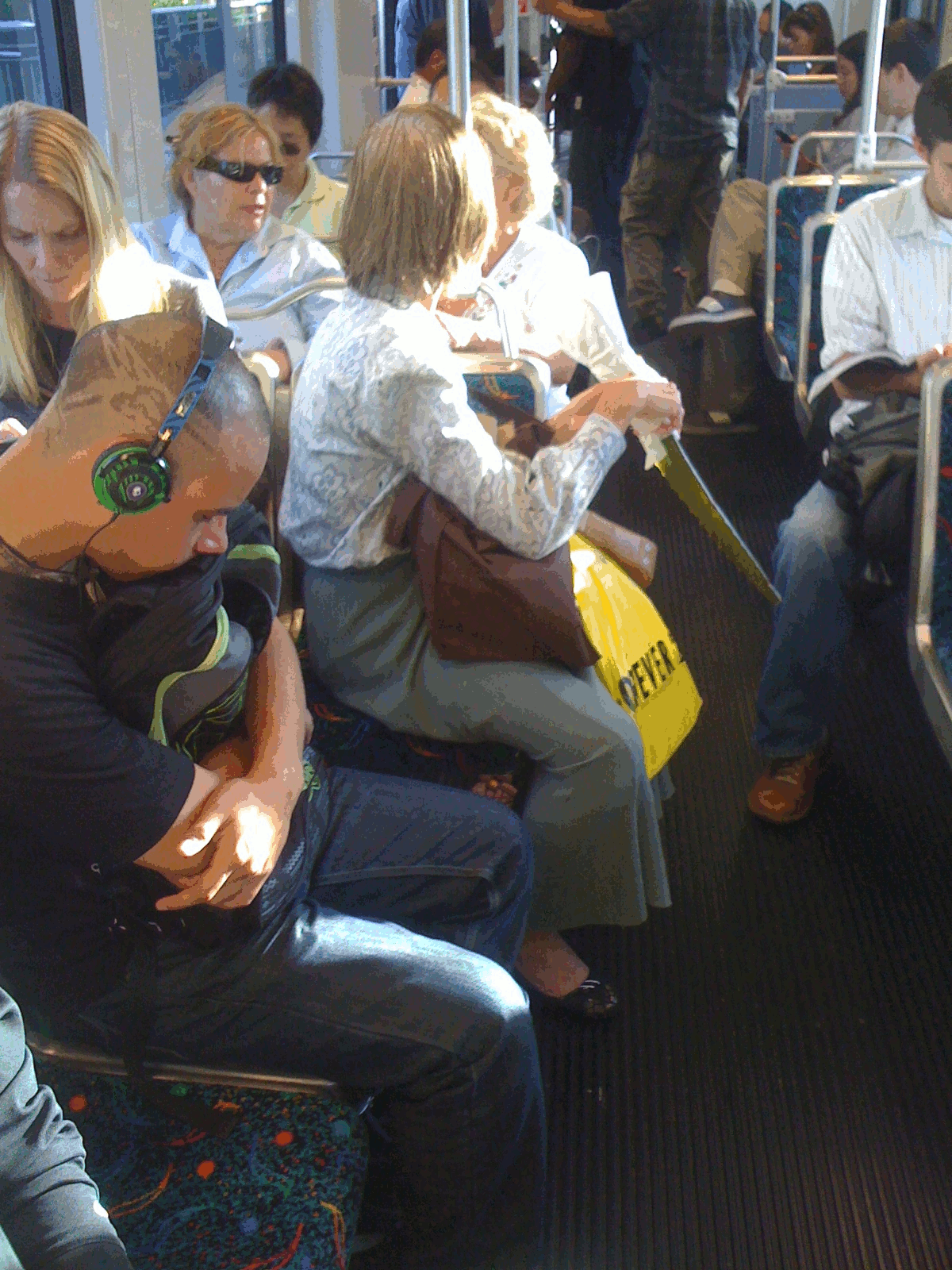
i've long thought that nurturing relationships with plants was an undervalued activity. if you look around, a whole lot of things you use come from plants (wood, rubber, most fabrics, etc). and i suppose the most important thing plants provide you (oxygen) can't even be seen. the ladies in the picture below became friends (if only for a train ride) over the gigantic green spear you see there.
i'm pretty sure said spear is an aloe plant and these women had quite an animated conversation about its various uses. and while the aloe may not help the lady holding it be forever 21, i'd be hard-pressed to believe it's hurtin things any.
Monday, September 12, 2011
confidence ...
she has it*.
* -- it's funnier if you say it in your head the way the guy in this video says "opulence, i has it." and yes, i believe that is a lauren conrad book.
Friday, September 9, 2011
big poles, big transformers
our electricity infrastructure has become such a pervasive part of our urban landscape that underground comic artist robert crumb needed a whole notebook of photographs to remind him to put them in his drawings. electrical lines overhead, the poles that hold them up, the transformers that make the energy usable and the electrical boxes both on the street and on the buildings, among other things, just kind of blend into the background for most of us.
from the blue line, you can see that for some people, thinking about all this stuff is a full-time job. the above picture is of a yard where the big poles reside before they're put in use for all of us to hang our yard sale and lost dog signs from. this particular morning, i got to see the big crane moving some of the poles. below are some really big transformers, similar to the ones that get mounted on the poles, but probably for a sub-station or industrial building.
and here are some people on a completely different section of the blue line training to be linemen. i wonder if any of them know that glen campbell song.
i suppose it's only fitting that all this stuff is viewable from an electrified train. it is all of these people and this stuff that keeps us moving on our journeys and, like our junk, it's better to see it where you use it so you can understand how things fit together.
Tuesday, September 6, 2011
alien invasion (or trash porn, pt 5)
i always knew the flats of lincoln heights housed some failed experiments of hill folk on mt washington. i always knew their aspirations for leaving the mount were thwarted and they discarded all reminders of such things with the only people they felt safe with. but i'm on to them now. i know their plans for reaching another galaxy never materialized and they thought the flatlanders were too stupid to ever realize what they had their hands on. but it's clear now. just look.
the people on the hill may be in the background there in the upper right, but their discarded ship is not forgotten. it's right in the lower left corner, stuck in a junkyard they didn't think anyone would see. no wonder they opposed the gold line. we blamed it on nimbyism then, but it's obvious now they just didn't want their space ship exposed for the world to see. too late!
or it's just another piece of junked artwork. alien conspiracy or junked art. i'm not really sure which, but one of them made me take this picture and share it with you.
Saturday, September 3, 2011
some policy wonkery
the brookings institution just put out this transit analysis. it's worth a read if the general topic of transit policy interests you. i know for most, it don't, so the main takeaways are there are a lot of transit riders in l.a., they are well-served by the various transit agencies in both coverage and service frequency and the average commute-time could use some improvement. the details follow.
l.a. ain't really known for its transit commuters. and yet, "Metro areas with a high number of transit commuters, such as Los Angeles, Honolulu, and Philadelphia, also stand out for having small per capita carbon emissions due to transportation compared with more car-dependent areas such as Nashville and Oklahoma City." it's official, l.a. has lots of transit users. i'd want some independent verification of the carbon emissions thing, but l.a. is no longer in the "more car-dependent" category.
as the city that created sprawl, there's a pretty strong notion that it's hard to find a bus or train stop in l.a., but that notion is just plain wrong. "Transit coverage is highest in Western metro areas such as Honolulu and Los Angeles, and lowest in Southern metro areas such as Chattanooga and Greenville." in fact, l.a. ranks second in both coverage and service frequency. in the above map (click to enlarge), dark blue means there is coverage, light blue means there isn't. i had to break it up by income (low on the left, high on the right) to avoid a solid mass of dark blue. mid income isn't shown, so not all areas are represented.
what l.a. could improve upon, however, is trip time. out of 100 metro areas, l.a.'s 25.6% is ranked 69th in percentage of jobs accessible in under 90 minutes. in the above map (click to enlarge), dark areas can be reached within 30 minutes and light areas can be reached in under 90 minutes. everything in between takes from 30-75 minutes. the left map uses downtown as a starting location (gray box, union station roughly). the right uses the westside as a starting location (santa monica and the 405 roughly).
despite l.a.'s 69th place ranking, based on sheer number of jobs the average worker has access to within a 90 minute transit commute, l.a. is second. in other words, a lot of jobs are really far, but there is no shortage of jobs that are really close. also, despite l.a.'s seemingly low ranking, "Notably, Chicago and Philadelphia—home to two of the oldest and best-known transit networks nationwide—rank lower on job access via transit than Houston and Los Angeles, both of which are known as auto-dominated metro areas."
one last little tidbit from the report: "Only one of 64 transit agencies surveyed recently reported that it has not had to reduce service or increase fares in response to larger fiscal challenges." there's been a lot of noise about mta doing this, but it seems budgetary pressures are being felt all around.
one last little tidbit for the nerds: "To make the full range of data behind this report more accessible and actionable, Brookings developed an online tool that enables users to examine the detailed results of this analysis." i found it at http://www.brookings.edu/metro/jobs_and_transit/Map.aspx, where i generated all of the maps in this post.
of course, this is just one study and its particular idiosyncrasies are going to bias the conclusions some way, some how. one addition i would like to see is "transit effectiveness," something along the lines of the ratio of average commute time driving alone in a car to average commute time on transit. nonetheless, it's good to have some validation that the l.a. transit system actually performs as well as i've been telling everyone.
i know i've had a lot of news/policy posts of late, crowding out my usual "things you probably wouldn't see anywhere but the train" posts. but i've got a soft spot for abstract policy discussions, so all i can do is hope the wonkery didn't put too many people to sleep.
Friday, September 2, 2011
ack ack ugckluh
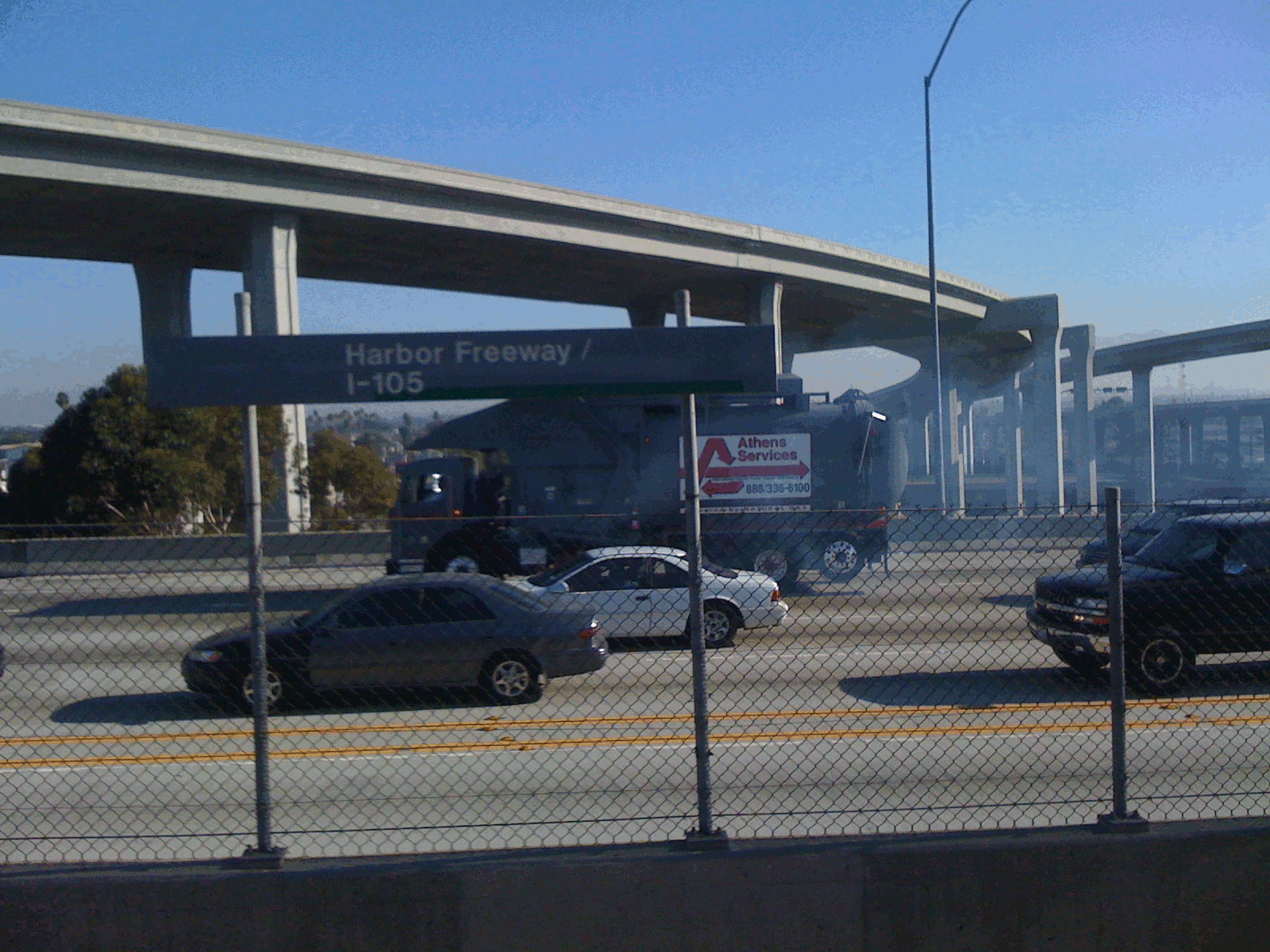
it always seems like a good idea to put trains along freeways. it makes planning a train trip almost the same as planning a driving trip. once i started riding the green line on a regular basis, it became clear that this is a good idea on paper only. the two pictures below show just one of the reasons why.
very few people i've ever ridden in a car with keep the windows open on the freeway. maybe it's because the wind is just too strong, but it also shields passengers from the concentration of pollution that forms from the sheer volume of traffic on a freeway. unfortunately, when standing on a train platform, there is no option to roll up the window.
there are other reasons having a train running down the middle of a freeway makes for a bad passenger experience. the rumbling and noise of the cars makes it hard to relax and even think. freeways' separation from pedestrian traffic adds another layer of complexity to getting on and off the platform. and, worst of all, stations tend to be located where freeway exits are, not such pedestrian friendly spots. on the other hand, the trains do get to run a lot faster, apparently fast enough to make an athens services truck smoke.
Subscribe to:
Posts (Atom)